
The Mitsubishi Ecodan R290 is a high performance heat pump eligible for the £7,500 heat pump BUS grant in 2026.
2026 Independent Verdict: Is the Mitsubishi Ecodan R290 worth it?
The Mitsubishi Ecodan R290 has fundamentally changed the UK retrofit market. By delivering 75°C flow temperatures, this Mitsubishi Ecodan provides a viable, direct replacement for gas boilers in older properties. Furthermore, our analysis confirms it remains the top-tier choice for reliability and ease of service in 2026. It is a premier heat pump for those looking to secure the £7,500 heat pump BUS grant.
*Verified against Mitsubishi Electric 2026 Technical Specifications and current UK MCS certification standards.Are you considering a Mitsubishi Ecodan for your home in 2026? As the UK moves closer to its net-zero targets, this heat pump has emerged as the most popular choice for homeowners transitioning away from gas and oil. However, with the Mitsubishi Ecodan R290 and the R32 Mitsubishi Electric heat pump now dominating the market, the standard advice from 2024 is already outdated.
In this expert guide, we move past the glossy brochures to look at real-world performance data. Whether you are weighing up Ecodan vs Daikin or searching for a qualified installer near you, we address the technical gaps often left out. We will explain the essential Ecodan MELCloud setup for smart energy tariffs and provide a transparent breakdown of how to secure the £7,500 heat pump BUS grant in 2026.
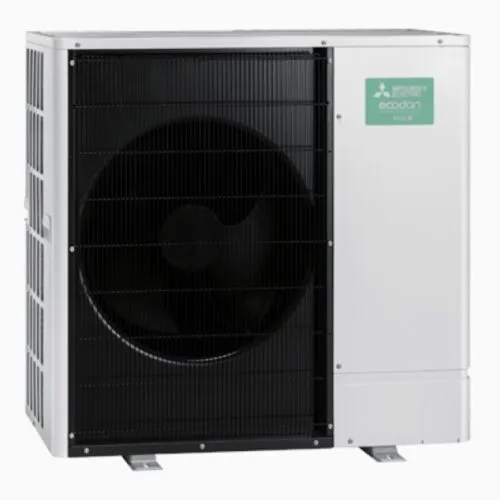
What Is the Mitsubishi Ecodan Heat Pump?
If you have been researching renewable heating in the UK, you have almost certainly come across the Mitsubishi Ecodan heat pump. It is one of the most trusted air to water systems available today. But what actually is it, and why is everyone talking about the new Ecodan R290?
At its core, the Ecodan is an air source heat pump (ASHP) that replaces your gas or oil boiler by extracting heat energy from outdoor air and turning it into usable heating and hot water for your home even when it is 20 degrees Celsius outside. Think of it like a fridge in reverse. While your fridge moves heat from inside to outside, the Ecodan does the opposite, pulling warmth from the air and pumping it indoors to heat your radiators, underfloor loops, and water cylinder.
The Mitsubishi Ecodan R290 vs R32
When comparing Mitsubishi Ecodan models, you’ll notice two different refrigerant types. While the newer Mitsubishi Ecodan R290 is more powerful, it is physically larger and heavier than the R32 Mitsubishi Electric heat pump compact models.
This size increase is because the R290 is a “monobloc” system. Since it uses propane to reach those high 75°C temperatures, the unit is built with extra safety housing and acoustic insulation to stay Quiet Mark compliant. Consequently, if you are weighing up Ecodan vs Daikin, remember that garden clearance for a heat pump isn’t just about airflow; you must also maintain specific safety zones away from drains or windows.
In addition, a Mitsubishi Ecodan installer (or any installer near you) will confirm these clearances during your survey to ensure you qualify for the £7,500 heat pump BUS grant. Once your Mitsubishi Electric heat pump is in place, the final Ecodan MELCloud setup gives you full smart control over your high-performance system.
| Model | Ideal For | Key Features |
|---|---|---|
| Mitsubishi Ecodan R32 (“The Efficiency Pro”) | New builds and homes with underfloor heating | A +++ efficiency, ultra quiet operation as low as 58 dB, proven reliability |
| Mitsubishi Ecodan R290 (“The Retrofit King”) | Older UK homes or radiator systems | Uses eco friendly propane R290, achieves 75 degree Celsius flow temps, perfect for replacing boilers without major upgrades |
Expert Tip: If you are comparing the best Ecodan heat pump model in 2026, look for the Ultra Quiet badge and Quiet Mark certification. This ensures smoother planning approval and a peaceful garden setup, a common issue in UK suburbs. Just remember that the R290’s extra power comes with a slightly larger physical footprint. Ensure your chosen spot has enough room for both the unit and the required airflow.
See our Ecodan model sizing guide for detailed specs on the 5 kW, 8.5 kW, and 14 kW units here
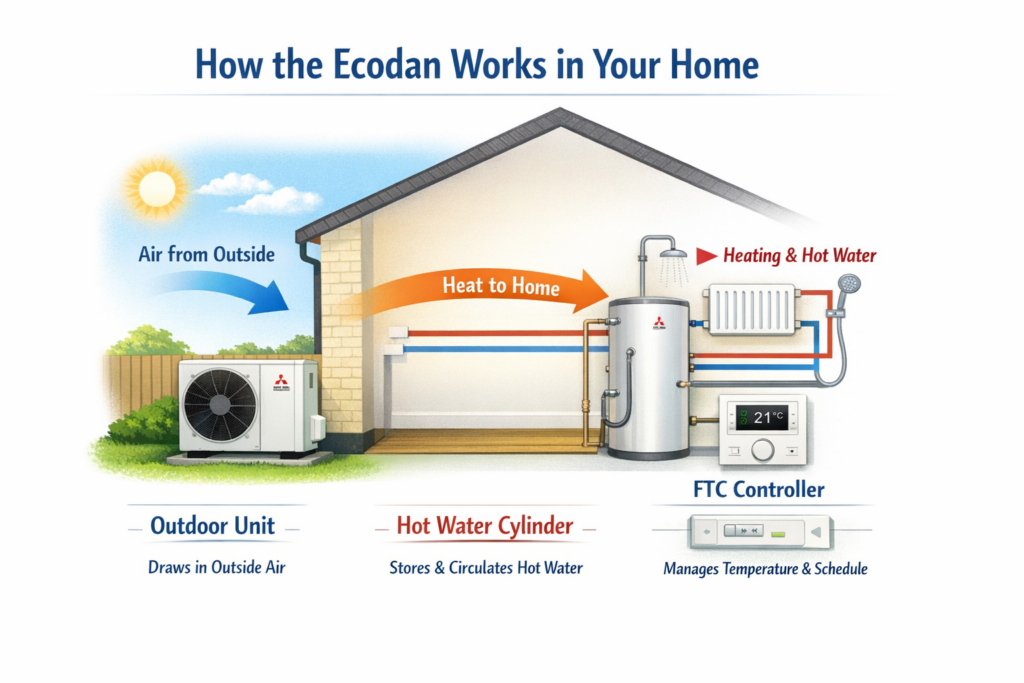
How the Ecodan Works in Your Home
Understanding how a Mitsubishi Electric Ecodan works is the moment everything becomes clear. This is where homeowners realise they are not simply buying a heating unit but upgrading to a future proof and energy efficient ecosystem.
Step 1: Capturing Natural Air Energy
Every Ecodan system starts with the outdoor unit that extracts heat energy from the air even when temperatures fall to 20 degrees Celsius below zero. Instead of burning fuel, the Ecodan captures ambient heat that already exists in the environment.
Example:
Think of the air outside like a sponge. Even on a freezing January morning in the UK at minus 5 degrees Celsius, the air still contains thermal energy. The Ecodan outdoor unit uses a specialized fan to pull this cold air over an internal heat exchanger. Because the refrigerant inside the unit is much colder than the outside air, it can still absorb heat from that freezing wind
Step 2: Transferring and Amplifying the Heat
Inside the Ecodan, a refrigerant circuit absorbs the captured energy and evaporates into a gas. A high precision inverter compressor then compresses that gas, raising its temperature and creating concentrated high grade heat.
Example:
Think of this like a bicycle pump. When you pump air into a tyre quickly, the nozzle gets hot. This happens because squeezing air into a small space creates heat.
The Ecodan does the same thing but much more powerfully. It takes the “cool” energy it gathered from outside and squeezes it using a compressor. This “big squeeze” turns that cool air into high-grade heat. In the 2026 R290 models, this process is so strong it can turn cold outdoor air into water hot enough (75 degrees Celsius) for your radiators.
Step 3: Delivering Heat to Your Home
The heated refrigerant passes through a plate heat exchanger inside the indoor cylinder. It transfers energy to the household heating water which then circulates through radiators, underfloor loops, and hot water taps.
Example:
Think of this like a kettle. Inside a kettle, the hot metal element never touches the water directly, but the heat passes through the metal to boil the water for your tea.
The Ecodan does the same thing. The hot gas from the pump passes through a set of metal plates, and your home’s water flows on the other side of those plates. The heat “jumps” across to the water, making it hot. This hot water is then pumped through your house to warm up your radiators, your underfloor heating, and your bathwater. It works just like a normal boiler system, but it uses the “squeezed” air energy instead of a flame.
Hot Water Cylinder Sizing & Hygiene Cycles
To ensure your 2026 Mitsubishi Ecodan installation is fully compliant and safe, your surveyor will pay close attention to your domestic hot water setup. Getting the Hot Water Cylinder Sizing right is essential, as heat pumps store water at slightly lower temperatures than gas boilers, meaning you generally need a larger tank to ensure you never run out of hot water.
Hot Water Cylinder Sizing (2026)
Most Mitsubishi Ecodan installs in England and Wales now use the following standard sizes to meet family needs:
- 200L: Ideal for 1–2 people with standard usage.
- 250L: The “gold standard” for 3–4 people.
- 300L+: Required for high-demand homes with multiple bathrooms or rain-head showers.
Hygiene and Safety: The Legionella Cycle
Furthermore, a common question from families is how heat pumps stay hygienic at lower operational temperatures. In addition to your daily heating, the Ecodan system automatically performs a weekly 60°C hygiene cycle (pasteurisation).
This short, intensive boost uses the immersion heater to protect your water supply against legionella bacteria. Consequently, while this adds a small, predictable amount to your running costs, it provides vital reassurance for families and ensures your home remains fully compliant with Building Regulations and MCS standards.
Why Sizing Matters for Your Grant
When you apply for the £7,500 heat pump BUS grant, your Mitsubishi Ecodan installer near you must prove that the cylinder is correctly matched to both the heat pump’s capacity and your household demand. Furthermore, an undersized cylinder will force the heat pump to work harder, whereas an oversized one leads to unnecessary standing heat loss.
The Heat Loss Calculation
To ensure your 2026 Mitsubishi Ecodan installation performs exactly as promised, there is one non-negotiable step: the professional Heat Loss Survey.
In 2026, a best guess simply isn’t good enough for a high performance Mitsubishi Electric heat pump. Every MCS-compliant installation now requires a forensic calculation of how much energy each individual room loses through its walls, windows, and floors.
Why the Survey is Your Secret Weapon
This technical assessment acts as the master blueprint for your entire project. Furthermore, it is the only way to accurately determine:
- The Perfect Unit Size: Whether your home requires the 5kW, 8.5kW, or 14kW Mitsubishi Ecodan.
- Radiator Upgrades: It identifies exactly which radiators can stay and which need replacing with “heat pump ready” versions to ensure your Ecodan remains efficiency.
- Target Flow Temperatures: This calculation is vital to ensure you can heat your home at the lowest possible cost.
- Planning Compliance: It verifies that the unit placement meets MCS 020 noise standards for your specific garden layout.
Why This Matters for Your Wallet
Skipping or rushing this stage is the primary cause of heat pump horror stories. A precise survey protects your investment by preventing:
- Oversizing: Buying a unit that is too large is not only more expensive upfront but also significantly less efficient.
- Noisy Cycling: An incorrectly sized heat pump will constantly turn on and off, which wears out the compressor and increases operational noise.
- High Bills: If the system isn’t matched to your home’s thermal “fingerprint,” it will work harder than necessary, draining your bank account via higher electricity rates.
See a Heat Loss Survey in Action
you might wonder what an engineer actually does during their visit. This quick guide shows the process of measuring up for a high efficiency heat pump system:
Understanding the physics of the Ecodan is only half the battle. The real question for the majority of homeowers in the Uk isn’t just how does it work, but ”will it work in my specific house without costing a fortune?”
2026 Property Suitability: Is Your Home Heat Pump Ready?
Before using the Mitsubishi Ecodan price UK calculators, you must address property readiness. In 2026, the Fabric First approach is the gold standard for efficiency.
Insulation Requirements
If you’re planning to apply for the £7,500 heat pump BUS grant in 2026, you’ll be glad to know the red tape has been cut. Forget the old rule that you must clear every insulation recommendation on your Energy Performance Certificate (EPC) before applying. The UK government removed this mandatory requirement to make getting a Mitsubishi Ecodan faster and more affordable for everyone.
The 2026 Rules at a Glance:
- Insulation Flexibility: You can now claim the full grant even if your EPC still recommends loft or cavity wall insulation. You are no longer forced to do this work to access the funding.
- Valid EPC Still Essential: While you don’t have to follow the insulation advice, you must have a valid EPC issued within the last 10 years. If yours has expired, you’ll need a new one before a Mitsubishi Ecodan installer near you can progress your application.
- Smart Efficiency: Although not a grant requirement, we still recommend insulating where possible. A “wrapped” home allows your Mitsubishi Electric heat pump to run at lower flow temperatures, which drastically reduces your monthly running costs.
The EPC “Uplift” and Property Value
Installing a Mitsubishi Ecodan R290 typically provides an immediate EPC uplift, often jumping a property from a D to a C or even a B rating. Consequently, this improved rating acts as a major win for several groups:
Mortgage Savings: Many “Green Mortgages” offer lower interest rates for homes rated C or above. In addition, once your Ecodan MELCloud setup is complete and your new rating is filed, you could move to a more competitive lending tier.
Landlords: Future proof your investment and meet 2026 rental compliance standards with ease.
Sellers: A high EPC is now a major selling point in the UK; buyers are actively looking for “heat-pump-ready” homes.
Consequently, we’ve made it simple to verify your funding. Use our interactive 2026 Grant Eligibility Checker below to get your result in seconds:
Ecodan Grant Eligibility Checker (2026)
The UK Government provides a non-repayable £7,500 grant to replace fossil fuel boilers with a Mitsubishi Ecodan. Check your 2026 status below:
The Cost of an Ecodan in 2026
Understanding the price is the next crucial step. It helps to differentiate the cost of the physical unit itself from the total price of a professional, certified installation.
While the standalone Mitsubishi Ecodan unit might have an average price tag of around £3,500, that is just the beginning. The total cost is significantly higher because a compliant installation requires expert labour, integration with your existing plumbing, necessary upgrades, and commissioning.
A full installation by an MCS-certified installer generally ranges from £8,000 to £12,000. The final price for your home will depend on specific factors like the size of your property, whether you need new or upgraded radiators, and any necessary changes to your pipework.
Do I Need an Electrical Upgrade?
One of the most frequent questions homeowners ask during a visit from a Mitsubishi Ecodan installer is whether their home’s wiring can handle the load. This is a common point of anxiety, but for the vast majority of UK properties, the answer is straightforward.
- Single-Phase is Standard: Most homes in England and Wales operate on single-phase electricity, which is perfectly capable of powering a Mitsubishi Ecodan R290 or R32.
- Typical Fuse Requirements: Depending on the unit size, a heat pump generally requires a 40A to 63A supply.
- No 3-Phase Needed: Unless you are heating an exceptionally large mansion or commercial space, you will not need a 3-phase electrical upgrade.
Furthermore, your installer will verify your “main fuse” rating during the initial survey. While upgrades to your fuse (e.g., from 60A to 80A or 100A) are sometimes required to ensure safety, they are not universal and are often handled easily by your local network operator. Consequently, having this confirmed early prevents “shock costs” later in the project and ensures your £7,500 heat pump BUS grant application moves forward without a hitch
While many homes can retain existing radiators with the powerful R290 system, final suitability depends on the specific heat loss calculations and your current radiator output. Consequently, these crucial factors are confirmed during a professional room by room survey.
See How Much You Can Save
The good news is that the total cost of your installation is immediately reduced by the £7,500 heat pump BUS grant. In 2026, your Mitsubishi Ecodan installer near you will deduct this amount upfront from your quote, so you only ever pay the remaining balance.
It is important to understand how your Mitsubishi Ecodan behaves during a cold UK winter. While these units are engineered to work perfectly at temperatures as low as -20°C, you may notice your heat pump occasionally pausing or even emitting what looks like a “steam plume.”
In addition to its normal heating cycle, the unit will periodically enter a defrost mode to melt any frost built up on the outdoor coils. You might see a white cloud of water vapour and hear the fan stop for a few minutes; this is a completely normal part of its operation and is not a fault.
Many homeowners worry that the heat pump will “stop working” or become too expensive when the temperature drops. To be honest, the efficiency (known as the COP) does decrease as it gets colder because the unit has to work harder to extract heat from the freezing air.
However, even when it is well below freezing, the Mitsubishi Ecodan R290 remains significantly more efficient than a gas boiler (roughly 0.9 COP) or a direct electric heater (1.0 COP).
| Outside Temp | Ecodan COP (at 35°C flow) | Ecodan COP (at 55°C flow) |
|---|---|---|
| +7°C (Mild) | approx. 4.8 | approx. 3.2 |
| -7°C (Freezing) | approx. 2.8 | approx. 2.1 |
Consequently, even on a freezing January night in 2026, a Mitsubishi Electric heat pump is still delivering over 200% efficiency. This means for every 1kW of electricity you pay for, you get over 2kW of heat for your home.
Want to get a clearer picture of your potential out of pocket expenses right now?
➡️ Use our cost calculator below to see how much you can save
Ecodan Cost & Savings Calculator (2026)
Compare the Efficiency Pro (R32) vs the Retrofit King (R290) based on your home type. Prices include the £7,500 BUS Grant deduction.
Mastering Your Running Costs in 2026
A common anxiety for new owners is the monthly running cost. Often, when homeowners complain about high bills, it’s not the heat pump’s fault it’s usually because they are missing out on the biggest innovation of 2026: Smart Tariff Integration.
To truly master your running costs in 2026, you need to move beyond basic wall timers. Modern Ecodan systems are now fully grid-aware. By using the MELCloud App (the free mobile and web application for controlling Mitsubishi Electric air conditioning and heating systems), you can automate your heating to follow dynamic pricing, effectively turning your home into a smart energy hub.
The Essential Ecodan MELCloud Setup
Completing your Ecodan MELCloud setup is the single most important step for any homeowner wanting to bridge the gap between standard heating and smart energy saving. In 2026, with the rise of agile electricity tariffs, this app acts as the “brain” of your system, allowing it to communicate with the grid in real-time.
Why Grid-Aware Heating Wins
- Octopus Intelligent & Agile Integration: You can shift your energy use to the cheapest hours of the day. We recommend scheduling your hot water cylinder to heat to 65°C during the 2 AM to 5 AM window, when electricity prices on smart tariffs are often 10p per kWh or lower.
- Thermal Mass Storage: Expert installers now recommend a technique called “overheating.” By using MELCloud to boost your underfloor heating zones by just 2°C during cheap overnight windows, you store energy in your concrete floors. The floor then acts as a thermal battery, releasing heat slowly throughout the day when electricity is expensive.
- Remote Efficiency Tweaks: If you’re stuck at work or away for the day, you can use the app to delay your heating boost, ensuring you aren’t wasting energy on an empty house.
- Performance Tracking: The app allows you to monitor your energy consumption in real-time, helping you identify precisely where you can hit that 20% saving target.
Getting Started
Your installer should provide you with a Wi-Fi interface (the small black box usually mounted near your indoor unit). Once that’s powered up, the Ecodan MELCloud setup takes just a few minutes: simply scan the QR code on the interface, connect it to your home Wi-Fi, and you’ll have full control of your Ecodan from your smartphone or tablet.
See the App in Action
To see exactly how the interface looks and how to navigate the menus for maximum efficiency, the video below is the best place to start.
While Mitsubishi has recently given the app a sleek visual makeover, the core Ecodan MELCloud setup principle remains exactly the same. The buttons you need to press on your controller and the steps to get your Wi-Fi interface online haven’t changed, making this guide the perfect walkthrough to get you started.
Solving the Efficiency Gap
Official Mitsubishi Electric manuals are notoriously technical, but most homeowners just need practical, “hands-on” guidance. The biggest win for your wallet is the Auto Adaptation feature.
Instead of a fixed temperature, this setting allows the system to automatically adjust flow temperatures based on real-time outside conditions. When configured properly, it can lower your electricity consumption by up to 20% compared to standard settings.
Step-by-Step Optimizer Guide
- Find the Icon: On your FTC wall controller, go to the Heating menu.
- Select Mode: Look for the Room Auto Adaptation icon (a small house with a thermometer).
- Set Your Target: Choose your ideal temperature (e.g., 20°C).
- The “Hands Off” Rule: For the first 48 hours, avoid changing the settings. The system needs this time to “profile” your home’s heat loss.
Watch: The 60-Second Auto Adaptation Setup
(Click play below to see exactly which buttons to press on your controller to activate maximum efficiency)
Expert Efficiency Tip: If you notice your radiators feel ”warm” rather than hot in this mode, do not panic. This is a sign that the Optimizer is working correctly. It is providing a steady, low energy flow to maintain comfort rather than wasting electricity on high temperature blasts.
The Quiet Mark Advantage
One of the biggest concerns for homeowners in 2026 is noise both for their own comfort and compliance with local planning rules. Mitsubishi Electric proactively designed their Ultra Quiet Ecodan range to meet these strict acoustic standards.
Models carrying the Quiet Mark certification operate at sound levels as low as fifty eight decibels (58 dB). To put that into perspective, that is quieter than a normal indoor conversation or the hum of a modern fridge freezer.
Why the “Ultra Quiet” badge matters to you:
- Planning Rule Compliance: In the UK, strict rules govern how loud outdoor heat pumps can be near your neighbour’s property boundary. This certification gives you peace of mind that your installation is likely to comply without needing complex acoustic reports.
- Neighbour Peace: A quiet unit means no complaints and a harmonious relationship with those next door.
- Better Efficiency: A quiet, low-vibration unit is often a sign of a well-engineered and efficient system (A+++ rated).
Check the Quiet Mark Difference
Want to see which specific models have achieved this award? You can use our interactive tool below to check the current certified models and their exact sound ratings below:
Quiet Mark Sound Checker (2026)
Select a model to see how it compares to common home sounds. These low decibel ratings are key for meeting UK planning rules (MCS 020) without needing extra soundproofing.
Expert View: At 58dB, the R32 sounds like a modern fridge-freezer. If you’re standing in your garden, it’s a gentle background hum that is easily masked by standard neighborhood noise.
Maintenance: Protecting the 2026 Diamond Warranty
Mitsubishi Electric offers a market-leading 7-year Diamond Warranty on the Ecodan range, but it isn’t “set and forget.” One detail often buried deep in the operation manual is that this protection is strictly conditional on regular maintenance.
The 12-Month Rule
To keep your warranty valid through 2026 and for the full seven years, you must have an annual service performed by an MCS-certified engineer. This isn’t just a paperwork exercise; the engineer must log the service with Mitsubishi to ensure your cover remains active. If you skip a year, you risk losing your protection.
What an Expert Service Actually Includes
A “friendly expert” service goes far beyond a quick visual check. Your engineer will focus on two critical areas:
Magnetic Filter Cleaning: Your installer should have fitted a magnetic filter to catch iron oxide (sludge) from your old radiators. Cleaning this out annually is vital; it prevents debris from entering the heat pump’s heat exchanger, which is the primary cause of efficiency drops and system failure
Glycol Concentration: Unlike a gas boiler, your Ecodan uses glycol (anti-freeze) in the outdoor pipes. The engineer will check the concentration levels to ensure your system is protected from freezing during a harsh UK winter, which prevents catastrophic pipe bursts.
Common Questions About Ecodan Systems
Yes. It operates efficiently in temperatures as low as 20 degrees Celsius below zero thanks to advanced defrost technology.
Yes. Ultra Quiet models run around fifty eight decibels which is quieter than a domestic fridge.
Yes. The R290 variant delivers flow temperatures up to seventy five degrees Celsius, making it suitable for standard radiator systems.
No. Most homes in England and Wales run on single-phase electricity, which is perfectly capable of powering a Mitsubishi Ecodan. Unless you are installing an exceptionally large commercial grade system, you will not need a 3-phase electrical upgrade.
This article is independently produced and reviewed by renewable energy specialists with more than ten years of experience in domestic heat pump systems. All performance figures and eligibility criteria have been cross checked with current UK MCS certification and government data for 2026.
Unlike retailer sites that simply list unit prices, we provide the Total Project Cost, which includes the mandatory cylinder upgrades and labour. By addressing the running cost anxiety through technical guidance on Auto Adaptation and Smart Tariffs, we provide the human insight that corporate brochures lack.
Continue Your Journey
- Estimate Your Savings via the ROI Calculator
- Check Your 7,500 Pound Grant Eligibility
- Compare Local Mitsubishi Accredited Installers
Copyright 2026 Renewable Energy Review UK. Data verified by MCS Certified Installers. Affiliate disclosure: We may earn a commission from qualified purchases through our partners at no extra cost to you.