
If you’re reading a Jackery power station review while trying to decide which portable power station UK model to buy in 2026, you’re not being fussy at all you’re just dealing with a genuinely confusing lineup.
On one page you’ll see older NMC Classic units, on the next you’ll see newer LiFePO4 v2 models, and then layered on top of that, you’ve got the big Jackery solar generator bundles all shouting for attention.
So instead of feeling confident, it’s completely normal to feel like you’re one click away from buying the wrong thing. (We’ve all done this before) This guide is here to slow that down and show you, step by step, which Jackery actually fits the way you live and saves you money.
In this is honest guide we will show you exactly how to:
- Check the real specs (not just the headline numbers)
- Explain F0 errors and other Jackery error codes
- Break down battery life and battery duration for everyday use
- Help you figure out which Jackery model genuinely fits your needs
Best Jackery Portable Power Stations
Use this as your quick cheat sheet before diving into the detailed Jackery power station review and full comparison table.
Best Overall for UK Home Backup: Jackery Explorer 1000 v2
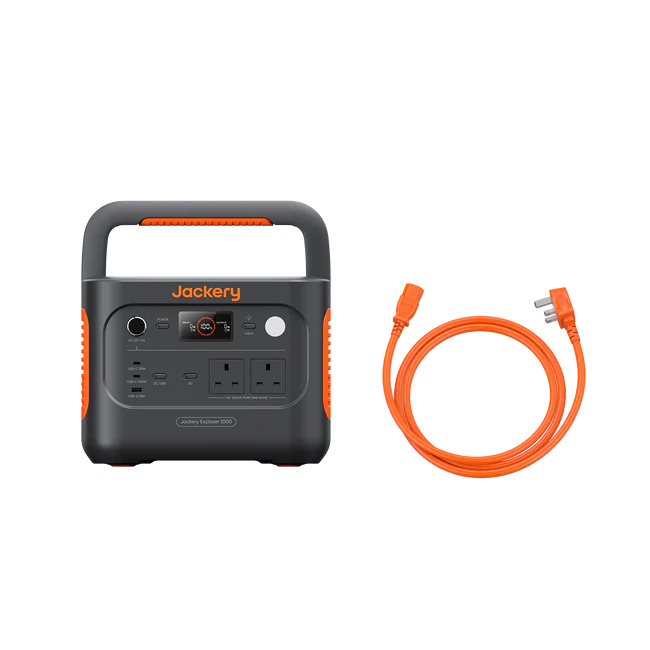
Why: If you want a single Jackery power station that can genuinely look after your home in a blackout, this is the 2026 sweet spot in the lineup. It replaces the older Pro models by pairing a long life 1070Wh LiFePO4 battery with a 1500W output, giving you a true one box solution that can comfortably run a fridge, router, and microwave simultaneously. And if you need a power station that can reliably go from 0–100% in around one hour using Emergency Charge mode in the app, the Jackery Explorer 1000 v2 is the only version that really delivers on that promise.
On top of that, Jackery has added its ChargeShield 2.0 system: 62 protection mechanisms, 12 forms of BMS protection, and 4 forms of physical protection constantly watch over the battery and electronics, so you’re not gambling with safety or lifespan every time you plug something in.
ChargeShield 2.0 is Jackery’s safety and charging management system. It monitors temperature, voltage, current, and charging speed so you can fast charge, emergency charge, or trickle charge a Jackery power station without cooking the battery or stressing it like cheap unknown name brands.
In real terms, that 1070Wh battery can charge:
- Wi-Fi router + a few LED lights: around 24–30 hours of continuous use during a power cut.
- Standard fridge/freezer: around 10–15 hours of compressor runtime, which in normal use is roughly a full day of keeping food cold.
- Laptop (work use): up to 15 hours of active charging for a typical 60W laptop.
- 55” TV + streaming box: around 7–9 hours of watching.
- CPAP machine: roughly 2–3 nights of sleep (depending on settings).
- Phones and smaller devices: easily 50–70 full phone charges, depending on the handset.
These are estimates (your exact runtime will depend on the specific devices and settings), but they give you a clear idea: if you want one Jackery that can realistically keep a small UK home or flat running through most outages and double as a serious camping / vanlife battery, the Explorer 1000 v2 is the one that actually fits that job.
If you’re not sure whether the Jackery 1000 v2 is worth it? [read our Jackery 1000 vs 1000 Pro comparison guide]
Best if You’re on a Budget: Jackery Explorer 500 v2
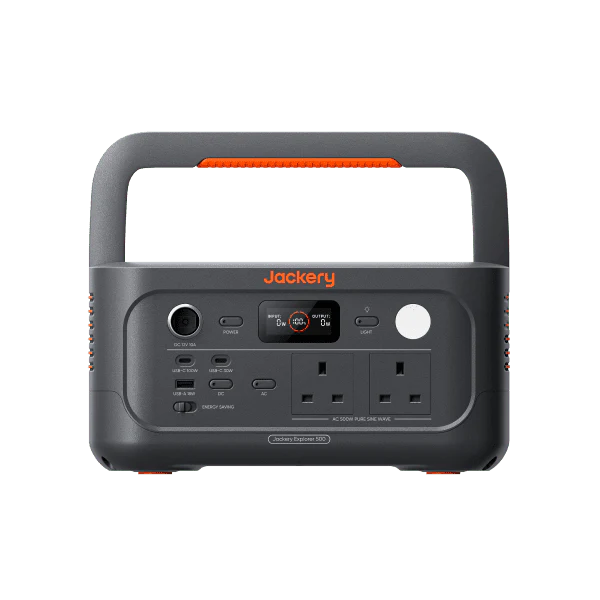
Why: If you want a power station that actually feels modern in 2026, the Jackery Explorer 500 v2 is the one that matters. It uses a 512Wh LiFePO4 battery (20Ah/25.6V) rated for around 6,000 cycles to 70%+ capacity, so you can use it every weekend for years without the battery feeling “tired” the way older NMC-based units do.
With a 500W AC output, dual USB-C (up to 100W), USB-A, and a 12V cigarette lighter port, it’s built for the stuff people actually use such as: mini fridges, routers, lights, laptops, CPAP machines, pumps, and coolers. At about 5.7 kg with a compact form factor, it’s light enough to carry around the house, into the garden, or into a car boot without feeling like gym equipment.
In real world terms, that 512Wh capacity roughly looks like:
- Wi-Fi router + a few LED lights: around 12–16 hours during an outage
- Small 60W mini fridge or cooler: around 5–8 hours of compressor runtime
- Laptop (60W work laptop): about 2–3 full charges or 6–7 hours of active use
- Phones and small devices: roughly 30–40 phone charges, depending on the handset
If you’re torn between stepping up to the 1000 v2 [see our Jackery 500 vs 1000 comparison]
Best Serious Home Backup + Solar Setup: Jackery Explorer 2000 Plus
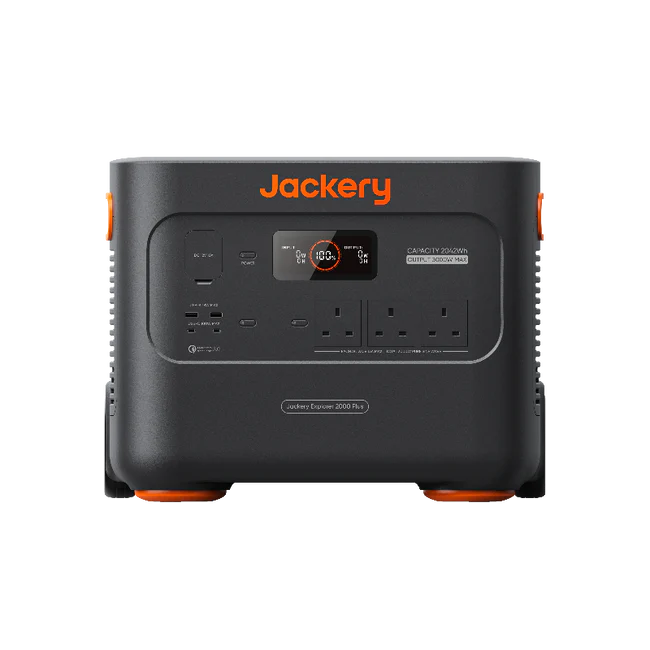
A 3000W output on a Jackery portable power station refers to its continuous AC power delivery. This determines how many highdemand appliances you can run at once as long as its under 3000W.
Unlike other high wattage portable power stations, this one isn’t just raw capacity it’s flexible capacity. That means whether you’re keeping a cabin live for days or running a mobile workstation with tools and heating, the 2000 Plus scales up or down depending on what you need. It’s one of the few systems that supports solar charging directly into the expansion batteries, cutting downtime and making full off-grid setups far more realistic.
It also features industry first ChargeShield technology, which boosts battery lifespan by 50% compared to fast charging competitors critical if you’re planning to rely on this every day or week. And with smart app control, UPS style functionality, and support for heavy tools (like 2200W weeders or 3000W kettles) it’s not just a backup it’s an absolute power hub.
In practical terms, the base 2kWh system looks like this:
- Fridge, Wi-Fi & LED Lights (150W average load)
Provides approximately 12 hours of total runtime. Because refrigerators cycle on and off, this typically translates to 24+ hours of actual home backup during a power cut. - Microwave (1050W)
Supports approximately 1 hour and 45 minutes of continuous cooking time. - Portable Air Conditioner (1150W)
Runs for approximately 1 hour and 35 minutes of continuous cooling on high mode. - High Drain Power Tools (1200W average)
Provides approximately 1 hour and 30 minutes of continuous trigger time. This is ideal for a full day of intermittent job site use. - Laptops & Tech Devices
Will recharge a standard 80Wh laptop approximately 20 times, or a high end smartphone roughly 150 times. - Modular Expansion
The base 2kWh unit is fully scalable. You can connect additional battery packs to reach 4kWh, 8kWh, or a maximum of 12kWh of stored energy.
The Explorer 2000 Plus can also handle a split second burst of 6000W to start heavy motors like air conditioners.
With a 2 hour solar recharge using six 200W panels, it’s also one of the few units in 2026 that realistically powers entire circuits and recharges fast enough to keep doing it even in UK winter daylight.
If your needs are more than just lights and phone charging, and you want something that can evolve into a full home backup or cabin system, this is the power station that earns its spot. It’s expens;ive, yes but the flexibility, durability, and 5 year warranty turn it into a long-term investment, not a gadget.
Use our Explorer 2000 Plus Calculator below to get a rough estimate of your expected running hours:
Running Time Simulator
Explorer 2000 Plus + Solar Setup
LiFePO4 Capacity: 2042.8Wh | Max Output: 3000W
Formula: (2042.8Wh × 0.85 efficiency) ÷ Total Watts.
*85% efficiency accounts for power conversion loss.
Best Ultra-Portable Device Charger: Jackery Explorer 240 v2

Why: If you mainly want something for weekends away, festivals or day trips, the Explorer 240 v2 is the ideal grab and go option. Unlike the original Jackery 240, which uses NMC cells with lower cycle life, the v2 version upgrades to LiFePO4 for much better longevity. It’s not designed for whole-home backup, but if you need a compact unit for roughly 15–20 phone charges, 3–4 laptop charges, or an evening of LED lights and a Wi-Fi router, this Jackery power station 240 v2 fits that role perfectly.
If you’re not sure whether to buy the original 240 or the newer LiFePO4 version, read our full [Jackery 240 vs 240 v2 review guide] to see exactly why the v2 is the only one that still makes sense in 2026.
Choosing the Right Jackery Explorer
In 2026, the real trap for UK buyers is accidentally buying the wrong generation of Jackery Portable Power Stations. While the model names (240, 500, 1000, 2000) have stayed the same for years, the battery chemistry and internal electronics have changed completely, leading to vastly different lifespans and performance.
On popular retail sites like Jackery UK and Amazon UK, you will typically see two generations sold side by side:
- Older Classic NMC Explorer units – based on battery technology developed years ago.
- Newer LiFePO4 v2 and Pro models – the current generation, built for 10+ years of use and thousands of charge cycles.
The central issue is that product listings often do not clearly distinguish between these generations, and in many cases, all versions are priced very closely together. This lack of transparency is exactly why so many buyers still end up with an Explorer 500 Classic in 2026, mistakenly believing it is the same as the newer, superior Explorer 500 v2.
In the next section of this guide, we will show you why those older NMC models are now genuine “Legacy Traps” and give you clear, actionable checks to quickly identify the future proof LiFePO4 versions before you buy so your money is going into a power station that can genuinely last you the next decade.
Read more: [Jackery 500 vs 1000 – Which Model Is Right for You?]
Read more: [Jackery Solar Generator UK Setup – Best Panels & Connections]
Read more: [Jackery 1000 UK vs 1000 Pro – Real Differences That Matter]
Read more: [Jackery Power Station 240 – Worth It in 2026?]
Why NMC Jackery Models Are a Legacy Trap vs LiFePO4
If you are considering the original Jackery Explorer 500, we strongly recommend pausing. That model uses NMC (Nickel Manganese Cobalt) batteries, which are limited to roughly 500–800 cycles before they lose 20% of their original capacity. By today’s standards, this is outdated technology.
Modern, high performance models like the Explorer 500 v2, Jackery power station 1000 v2, and Explorer 2000 Plus utilize LiFePO4 (Lithium Iron Phosphate). These are rated for an impressive 3,000–4,000+ charge cycles.
To put this in perspective, think about your smartphone. Most phones use NMC batteries that start to die after just 2 or 3 years of daily charging. That is exactly what happens to a Jackery explorer 500.
In contrast, a LiFePO4 battery is more like the engine of a high mileage taxi. It is built to be used every single day for over a decade. In practical terms, that is the difference between your portable power station lasting 2 years of heavy daily use or 10 to 15 years.
Expert Tip: A Jackery Explorer 500 v2 at £299 is a significantly better investment than a Classic 500 at £269 even if the £30 difference looks like a tempting deal on Amazon.
The shift to a more superior battery is also where Jackery pulls ahead of many small no name brands. You are not just buying watt hours; you are essentially buying cycle life, safety, and reliability from a company that has been refining portable power stations for over a decade.
Consequently, when you buy through the official Jackery website you are ensuring your home has a portable solar generator that won’t fail when the grid does. Unlike generic units that may overheat, Jackery’s 2026 lineup features ChargeShield technology, providing a unique 62-point protection system for the battery. Ultimately, not wasting money on a unit that isn’t built for the long haul.
Want to make sure you’re getting the newer LiFePO4 version and full UK warranty?
Buy direct from Jackery’s official UK site
2. Charging Your Jackery Power Station in 2026
The original Jackery power station 500 takes around 7.5 hours to charge from a standard UK wall socket. In 2026, that is simply too slow. By comparison, the newer Explorer 500 v2 can go from empty to full in about 1.3 hours, and the Jackery 1000 v2 can reach 100% in roughly 1 hour.
Why Charge Speed Actually Matters
If you only have short windows to charge e.g. after work, between trips, or during a brief break in a power cut a 7.5-hour recharge time is a real problem. If you need your Jackery for:
- an evening of working from home,
- a planned outage,
- a weekend away where you can only plug in for an hour or two,
then being able to refill the battery in around 1 hour instead of all day makes a huge difference. With the v2 models, you can plug in while you cook dinner or watch a film and realistically expect a full battery before bed.
At a typical UK tariff of around £0.27 per kWh, fully charging a Jackery 1000w (about 1kWh battery capacity) from the wall costs roughly 27p. That makes it incredibly cheap to keep topped up in the background as a standby home backup power station, ready to step in the moment the lights go out.
3. Jackery Product Comparison Table
| Model | Primary Use Case | Why People Choose It | Common Daily Applications | Avoid If |
|---|---|---|---|---|
| Explorer 240 (Classic) | Day Trips | Smallest entry point for basic electronics uses older NMC tech. | Charging phones (24x), tablets, or a 30W LED light for ~12 hours. | You want fast charging the 240 v2 recharges in 1hr vs 5hrs for this classic. |
| Explorer 240 v2 | The Day-Tripper | Ultra portable (3.6kg) uses LiFePO4 for 10+ years of weekend use. | Powering a Starlink Mini (5h), drones, or fast-charging a laptop via 100W USB-C. | You need to run a 12V fridge the 500 v2 offers more reliable runtime. |
| Explorer 500 (Classic) | Budget Camping | Established 500W output for basic campsite comfort. | Running a mini-fridge (9h) or a small TV (7h) for a single evening. | You need long-term durability; this unit is rated for only 800 cycles. |
| Explorer 500 v2 | The Weekend Solo | High-efficiency LFP battery with an industry-leading 6,000-cycle life. | Boiling low-wattage travel kettles, 60W coolers (4.5h), or medical CPAP machines. | You need to power high-draw kitchen gear; use the 1000 v2 for 1500W output. |
| Explorer 1000 (Classic) | Legacy Vanlife | Budget-friendly high capacity for older off-grid setups. | Basic refrigeration and charging multiple devices simultaneously. | You want modern safety; the 1000 v2 has much faster charging and a longer life. |
| Explorer 1000 v2 | The Vanlife Hub | 2026 “Sweet Spot” with 1500W output and a 1-hour “Emergency Charge”. | Powering standard coffee makers, full-size fridges, and UK travel kettles (<1500W). | You need serious home backup; the 2000 Plus is better for multi-day outages. |
| Explorer 2000 Plus | RV / Major Backup | Massive 3000W output; expandable from 2kWh up to 12kWh. | Running 3kW UK kettles, RV air conditioning, or essential home circuits for 24h+. | You are traveling solo; the 1000 v2 is significantly lighter and more manageable. |
- [Jackery 500 review – Classic vs 500 v2]
- [Jackery 1000 review – Real UK runtimes & tests]
- [Jackery solar generator review – 500, 1000, 2000 Plus compared]
4. Best Jackery Models for UK Home Backup in 2026
- Jackery Explorer 240 v2 – Personal Power Only
- Capability: Perfect for keeping a Wi-Fi router live for ~16 hours and topping up phones or laptops.
- Limitation: With only a 300W output, it cannot run fridges or kettles.
- Verdict: Use it as a portable tech charger, not for home backup.
- Jackery Explorer 500 v2 – Minimum Viable Backup
- Capability: Powers essentials like Wi-Fi, lights, and laptops through a typical evening outage.
- The “Tight” Spot: Can run an efficient fridge for ~4.5 hours, but you must be careful.
- Verdict: This is the first “proper” unit that feels like a backup solution rather than just a big battery.
- Jackery Explorer 1000 v2 – The “Sweet Spot”
- Capability: Realistic backup for a full-sized fridge/freezer, TV, and mesh Wi-Fi.
- Feature: Includes 20ms UPS technology to keep your devices online without a break during a cut.
- Verdict: The best balance of price and performance for most UK homes.
- Jackery Explorer 2000 Plus – Serious Home Independence
- Capability: A powerhouse that handles heavy-duty appliances like 3kW UK kettles and power tools.
- Expandable: You can chain up to five Battery Pack 2000 Plus units to reach a massive 12kWh capacity.
- Verdict: Maximum peace of mind for multi-day outages.
The Two Best Solar Generator Setups for 2026
For true energy independence, these bundles combine the power station with high-efficiency SolarSaga panels:
- Jackery Solar Generator 1000 v2 (100W Kit): The top choice for portable emergency solar. It recharges quickly and is light enough to move as the sun shifts.
- Jackery Solar Generator 2000 Plus (200W Kit): This is a serious off-grid solution. With multiple 200W panels, it can fully recharge in just 2 hours under optimal sun.
Don’t get stuck in the dark: [Read our full guide and comparison on Jackery Solar Generators here]
Jackery Portable Power Station ”F” errors
If your Jackery power station suddenly displays a mysterious “F” error code or refuses to charge, don’t panic just yet. While these units are engineered for a 10 year lifespan, minor software glitches or safety triggers can occasionally interrupt your power. These codes, ranging from F0 to F9, are actually part of an advanced diagnostic system designed to protect your battery from permanent damage.
Most of the time, these codes are just a safety warning that something needs a quick adjustment:
- F0, F1, F2, & F7: These usually point to internal communication faults or power supply module issues.
- F3: Battery Failure. This is a more serious alert often requiring a reset or support if it doesn’t clear.
- F4 & F5: Battery Overvoltage or Undervoltage. Often caused by input voltage that is too high or a battery that has dipped below safe levels.
- F6: Inverter Abnormal. Typically triggered by an overload or high solar input; unplugging everything usually lets it recover automatically.
- F8 & F9: Overcurrent/Short Circuit. Safety triggers that kick in if a device pulls too much power from the DC or AC ports.
Don’t get stuck without power: [Read our Instant Fixes for Jackery F-Errors guide]
Read more: [Why Is My Jackery 1000 Not Charging? Common Cold Weather Fixes]
7. Maintenance: Protecting Your 2026 Investment
Whether you have the lightweight Jackery 240 UK or the heavy-duty Explorer 2000 Plus, how you store it determines if it will last its full 4,000-cycle lifespan.
- The 20/80 Rule:
For long-term storage, don’t leave the unit at 100% or 0%. Keeping it between 20% and 80% charge significantly reduces stress on the battery chemistry. - Calibration:
Every 3 months, you should “deep cycle” the unit. Discharge it to 0% and charge it back to 100% in one go. This helps the internal computer accurately report the Jackery 1000 weight, percentage and remaining runtime. - Port Care:
UK salt air can cause minor corrosion. Give your ports a quick blast of compressed air to keep the connections clean for your Jackery solar generator and Jackery portable power station plugs.
9. Why Pick Jackery Instead of Another Brand?
1. Proven, Mature Product Line
2. Simplicity and Usability
Jackery’s interfaces are:
- Simple front panels
- Clear displays
- No over-complicated menus
For many UK buyers (especially for home backup), this matters more than “nerdy” features. In an actual power cut, you want something your family can use without a manual.
3. Strong UK Support & Jackery Amazon Presence
Because Jackery is widely sold on Jackery Amazon and via UK partners, you benefit from:
- Familiar returns and warranty flows
- Easy spare parts or replacements
- Lots of real user reviews on each model
With some lesser-known brands, if something goes wrong, you’re stuck with email-only support and slow responses. With Jackery, you’re working with a brand that has already built trust in the UK.
4. Safer Chemistries and Honest Ratings
The shift to LiFePO4 across key models means:
- Safer storage in homes, garages, campervans
- Much longer cycle life
- More consistent output over the years
And unlike no-name “1000W” units with inflated claims, the Jackery 1000w and Jackery 2000 Plus ratings are realistic. You’re paying for what you actually get.
5. Resale Value
If you ever decide to upgrade later (e.g. from a Jackery power station 500 to a Jackery power station 1000), Jackery gear holds value on the second-hand market. That effectively reduces your “real” cost of ownership.
Put simply: if you want a power station you can trust for the next 5–10 years, Jackery is one of the safest bets in the UK market right now.