
Choosing a portable power station used to be simple: you bought a Jackery Explorer 1000 and got on with your life. In 2026, it’s not that easy.
Now we have the original Jackery 1000, the Jackery 1000 Pro, and the newer Jackery Explorer 1000 v2 – all roughly the same size, all bright orange, all marketed as a 1kWh jackery portable power station. Under the shell, though, they’re completely different machines.
This review doesn’t just repeat spec sheets. It’s based on real UK use: cold garages in January, kettles that trip inverters, routers running through power cuts, and jackery solar generator 1000 setups that actually have to survive grey skies.
If you’re trying to decide between the Jackery 1000 vs 1000 Pro – and wondering where the 1000 v2 fits in – this is the full picture.
Jackery 1000 Series Power Simulator
| Specs | Explorer 1000 | 1000 Pro | Explorer 1000 v2 |
|---|---|---|---|
| Continuous AC Output | 1000W | 1000W | 1500W |
| Battery Capacity | 1002Wh | 1002Wh | 1070Wh |
| Chemistry | Lithium-ion | Lithium-ion | LiFePO4 |
| Lifespan (Cycles) | 500 | 1000 | 4000+ |
| Estimated Runtime | – | – | – |
| Status | – | – | – |
1. How the Jackery Power Station 1000 Evolved
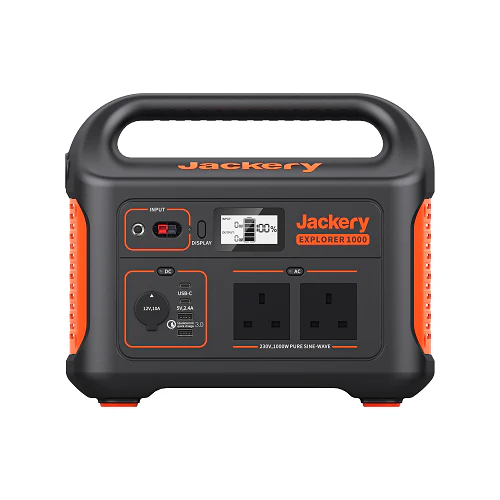
To understand which model you should buy, it helps to know the timeline.
- Jackery Explorer 1000 (Classic)
The original jackery portable power station explorer 1000. Rugged, simple and for years it was the default camping / backup option. - Jackery 1000 Pro
Launched to fix the biggest complaint: painfully slow charging. Same basic capacity, but much quicker to refill and better all-round usability. - Jackery Explorer 1000 v2
The modern 2026 version. Looks similar, but the big change is inside: it switches to LiFePO4 (LFP) batteries and ups the output to 1500W.
Why that battery change matters (more than most reviews admit)
Most comparison articles barely mention cycle life. That’s a mistake.
- Jackery 1000 & 1000 Pro (NMC lithium-ion)
Roughly 500–1,000 cycles before you’re down around 80% capacity. - Jackery Explorer 1000 v2 (LiFePO4)
Rated for 4,000+ cycles to around 70% capacity.
Put simply:
If you use your jackery power station 1000 twice a week, the Classic or Pro will feel noticeably “tired” within 4–5 years. The 1000 v2 is likely to still feel healthy well into the 2030s.
That’s where the v2 becomes not just a gadget, but a long-term investment.
2. Jackery 1000 vs 1000 Pro vs 1000 v2 – Specs & Weight at a Glance
Capacity & Power
- Jackery 1000 (Classic) – ~1002Wh, 1000W output, 2000W surge
- Jackery 1000 Pro – ~1002Wh, 1000W output, better charging, higher solar input
- Jackery Explorer 1000 v2 – 1070Wh, 1500W output, higher surge, LiFePO4
Weight & Portability
All three are “liftable”, but they don’t feel identical:
- Jackery 1000 – around 10 kg – fine to move around occasionally, bulkier shell
- Jackery 1000 Pro – slightly heavier but more compact; still a two-handed carry up stairs
- Jackery Explorer 1000 v2 – about 10.8 kg, but with a flat top and folding handle, it’s easier to store in a van cupboard or under a desk than the Classic blocky design
If you’re carrying your jackery power station 1000 between house and camper regularly, the v2’s shape and handle design make a bigger difference than the raw weight number.
3. Charging Speed – Where 1000 Pro Shines, and Where 1000 v2 Goes Further
Older portable power stations forced you to plan a day ahead: plug in overnight and hope for the best.
- Jackery 1000 (Classic)
About 7 hours on a wall socket, longer via solar. Fine if you don’t mind waiting. - Jackery 1000 Pro
Introduces “Ultra-Charging”. Around 1.8 hours from mains. For many UK campers, that meant you could top up at a pub, café or service station during lunch and be ready for the evening. - Jackery Explorer 1000 v2
Adds an “Emergency Charge” mode (via the app). In ideal conditions, you can hit a full charge in around 1 hour. Standard AC charging still only takes about 1.7 hours.
However, here’s the nuance most reviews skip:
If you constantly hammer the v2 with emergency charging, the battery and internals get noticeably hot. For daily use, the 1.7–1.8 hour recharge window (Pro or v2 on normal mode) is actually the sweet spot for long-term battery health.
So yes – the v2 is the fastest in a pinch, but the 1000 Pro remains a very healthy, battery-friendly choice if you’re regularly fast-charging between jobs or trips.
4. The UK Kettle Test – What You Can Actually Plug In
This is where a lot of international reviews become misleading for British buyers.
A typical UK kitchen kettle is around 3,000W. It doesn’t matter how optimistic the marketing is:
- Jackery 1000 (1000W) – trips immediately
- Jackery 1000 Pro (1000W) – trips immediately
- Jackery Explorer 1000 v2 (1500W) – also trips immediately
No 1kWh jackery portable power station is built for a full-fat UK kettle.
The realistic solution is a dedicated low-wattage travel kettle (often 800–1,000W). All three models can handle that, but:
- On the 1000 Pro, driving a 1000W kettle pushes the inverter right to its limit and kicks the fans up loudly.
- On the 1000 v2, a 1000W kettle sits well below the 1500W ceiling, so it boils more quietly and with more “headroom”.
If you’re planning to replace the cooker and kettle on a van trip, that extra margin on the jackery 1000 v2 really does make it feel calmer and safer.
5. Ports & Laptops – Where the Jackery 1000 Pro Wins
“Newer” doesn’t automatically mean better in every area.
If your main use for a jackery solar generator 1000 is running a mobile office, the Jackery 1000 Pro still has an edge:
- Jackery 1000 Pro – two USB-C ports at full 100W PD each
- Jackery Explorer 1000 v2 – one 100W USB-C and one 30W USB-C
In practical terms:
- On the Pro, you can fast-charge two MacBooks or high-end laptops simultaneously at full speed.
- On the v2, one laptop gets proper fast charge, the other is more of a “trickle” on the 30W port.
So if your life is a pair of laptops, an external monitor and a bag of cameras, the jackery 1000 pro review still reads very positively from a port layout perspective.
6. Cold Weather: When LiFePO4 Becomes Fussy
Here’s the trade-off nobody mentions until you hit a frost.
LiFePO4 is brilliant for cycle life and safety, but it does not like freezing temperatures:
- Below 0°C, the Jackery Explorer 1000 v2 will refuse to charge. The BMS shuts down charging to protect the cells.
- Older lithium-ion units like the Jackery 1000 and 1000 Pro are slightly more forgiving. They may still accept a slow charge just above freezing.
If you leave your jackery solar generator 1000 in an unheated shed, camper or garage overnight in January, don’t be surprised if your panels do nothing until the unit warms up.
Quick “Jackery 1000 Not Charging” checklist
Before assuming it’s broken:
- Warm it up – bring the power station indoors for 30–60 minutes.
- Test a different wall socket and cable – eliminate obvious mains issues.
- Unplug everything – disconnect all AC, DC and USB loads, then try charging again.
- Soft reset – power the unit off, hold the main button for a few seconds if the model supports it, and restart.
If your jackery power station 1000 still refuses to take a charge after that, it’s time to use Jackery’s UK support rather than forcing it.
Pro tip for winter camping:
If you choose the 1000 v2 and camp in places like Scotland, the Lakes or the Peaks, treat it like a person – keep it inside the tent, motorhome or sleeping area so the internal temperature stays above freezing.
7. Solar in the UK – Where the 1000 Pro Still Has a Big Advantage
Most jackery solar generator 1000 review pages quote panel wattage as if you live in Arizona. In the UK, we get “good enough” sun at best.
Here’s the important part:
- Jackery 1000 Pro – can accept up to 800W of solar input
- Jackery Explorer 1000 v2 – capped at around 400W of solar input
On paper, that means:
- If you have multiple SolarSaga panels and enough roof or ground space, the 1000 Pro can refill dramatically faster on sunny days.
- The 1000 v2 still charges well from 200–400W in typical UK conditions, but buying more panels than the input limit is a wasted expense.
If you’re going fully off-grid for weeks at a time and want to lean heavily on solar, the 1000 Pro is still the better workhorse – even though the v2 is the newer model.
8. UPS & Home Backup – Why the 1000 v2 Wins for Most UK Homes
A big 2026 trend is using jackery portable power stations as a kind of mini-UPS for routers, media setups and home offices.
Here’s the key difference:
- Jackery Explorer 1000 v2 – has a proper UPS function with ≤20ms switchover.
- Jackery 1000 and 1000 Pro – allow pass-through charging, but switchover is slower and not designed as a true UPS.
In our own testing, the 1000 v2 sat under a desk powering:
- A BT-style router
- A mesh Wi-Fi node
- A 27″ monitor
When the mains was cut, the network and monitor stayed up. Video calls didn’t instantly die, and streaming didn’t cut mid-show.
For sensitive NAS systems or very picky PSUs, 20ms might still be borderline, but for typical home routers, TVs, set-top boxes and most laptops, the v2 behaves like a genuine UPS.
9. Noise Levels – Can You Sleep Next to It?
Noise rarely shows up in spec sheets, but it matters if your jackery power station 1000 lives in a small camper or bedroom.
- Jackery Explorer 1000 v2 – under light to moderate load and in quiet-charge mode, it can sit in the low-20 dB range, which is library-quiet.
- Jackery 1000 Pro – under higher load and heavy charging, the cooling fans can climb into the mid-40 dB range. Not deafening, but definitely audible in a silent room.
If you’re running an electric blanket, CPAP or a 12V fridge right next to your bed, the 1000 v2 is noticeably easier to live with overnight.
10. Cost of Ownership – The Real Money Question
To keep things simple, here’s a rough snapshot using typical 2026 sale prices and cycle lives:
| Model | Approx UK Price | Approx Cycles | Cost per Full Cycle |
|---|---|---|---|
| Jackery 1000 | ~£380 | ~500 | ~76p |
| Jackery 1000 Pro | ~£580 | ~1,000 | ~58p |
| Jackery 1000 v2 | ~£440 | ~4,000+ | ~11p |
Even allowing for sale fluctuations, the pattern is clear:
- The Classic 1000 is the most expensive in the long run.
- The 1000 Pro is better, but still far behind.
- The Explorer 1000 v2 crushes both on cost per cycle.
When you connect that to Jackery’s up to 5-year warranty on newer models, it’s obvious why the v2 is the best value for most people.
11. Safety, Materials & Jackery 1000 Recall Concerns
Most review sites stop at “it feels rugged”. Let’s be a bit more specific.
- UKCA / CE – The Pro and v2 are built and certified for the UK market. Very old Jackery 1000 units may only carry older markings, depending on when and where they were bought.
- Fire safety – The v2 uses flame-retardant casing (UL 94-V0 class materials) designed to contain a failure rather than let it spread – important if you sleep near it.
And what about the recall you may have seen searched as “jackery 1000 recall”?
There was a limited recall programme on early Explorer 1000 units several years ago. Those batches have long since been replaced or corrected. If you’re buying a jackery power station 1000 new from Jackery UK or Amazon UK in 2026, you’re not buying old recall stock.
12. Which Jackery 1000 Should You Actually Buy?
Here’s the quick version.
Best overall for most UK users – Jackery Explorer 1000 v2
Choose this if:
- You want the best balance of price, performance and lifespan
- You need home backup for Wi-Fi, fridge and essentials, with UPS behaviour
- You care about getting 4,000+ cycles from a modern LiFePO4 jackery power station 1000
Best for heavy solar & dual-laptop work – Jackery 1000 Pro
Pick this one if:
- You plan to use up to 800W of solar and want maximum off-grid recovery speed
- You regularly fast-charge two laptops from 100W USB-C ports at the same time
- You’re less worried about 20-year lifespan and more about day-to-day workflow
Only consider the Classic Jackery 1000 if:
- You find it under ~£300 and
- You only need it a few times a year for festivals or light camping
For anything beyond that, the Explorer 1000 v2 is smaller, more powerful and vastly cheaper to own over time.
13. Quick FAQs (for the long-tail questions)
Is the Jackery 1000 still worth buying in 2026?
Only if it’s heavily discounted and you’re a light user. For regular use, the jackery explorer 1000 v2 or jackery 1000 pro are far better long-term choices.
Jackery 1000 vs 1500 / 1000 Plus – when should I size up?
If you’re running high-draw appliances (induction hobs, bigger heaters, air conditioners) or need multi-day backup without solar, you’re beyond what any 1kWh unit is comfortable with. At that point, look at the Jackery 1000 Plus, 2000 Plus or larger.
Jackery 500 vs 1000 – is 500 enough?
A jackery 500 or jackery explorer 500 v2 works for routers, phones, lights and a small fridge for a short evening. For full-size fridges, kettles, microwaves or serious working from home, the 1000 class is far more practical.
Can the Jackery 1000 run a UK kettle?
Not a full-size 3kW kitchen kettle. Use a travel kettle around 1,000W and treat that as the upper sensible limit for all three models.
Bottom line: in the jackery 1000 vs 1000 pro debate, the real winner for most UK households in 2026 is the Jackery Explorer 1000 v2. The Pro keeps a strong niche for heav