
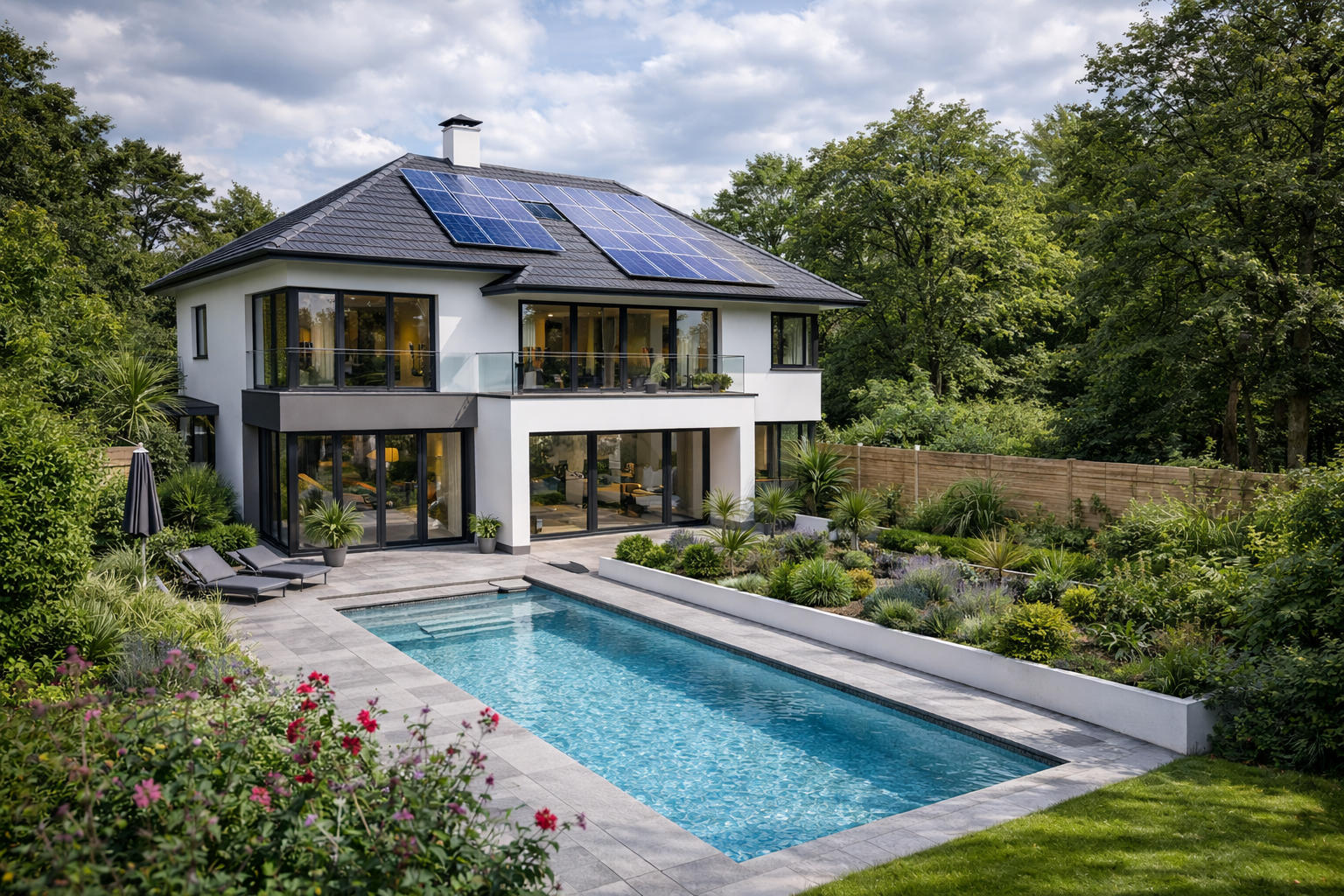
This in-depth 2026 guide breaks down everything UK homeowners need to know about heating a swimming pool with solar. We’ve covered it all from cost saving comparisons to the latest VAT-free installation insights.
[simple-author-box]
Updated: December, 23, 2025 | Reviewed by: EcoAdvisors Editorial Team
Grab a coffee! This is the definitive 2026 blueprint for heating a swimming pool with solar energy. We’ve skipped the fluff and packed in the hard data you need to save thousands this season.
Heating a swimming pool with solar in the UK is no longer just a dream for tech hobbyists. It is a smart, calculated defense against the high cost energy era we now live in. We’ve all felt the weight of those bills lately, and in 2026, nobody wants their backyard oasis to feel like a ‘money pit.’
Choosing solar thermal technology is the ultimate way to flip the script. You are turning a potential financial drain back into the luxury asset it was meant to be. Whether you are relaxing in a sleek new build or a quiet countryside retreat, this is the smartest way to maintain inviting temperatures without the 28p per unit anxiety that usually comes with a heated pool.
The best part? The science is simple, even if the British weather isn’t. We are going to break down exactly how modern collectors harvest ‘grey light’ in the UK, why the 2026 math finally makes sense, and how you can lock in 0% VAT on your setup before the rules change.
“EcoAdvisors is reader supported. When you purchase through links on our site, we may earn an affiliate commission. This helps fund our 2026 independent testing and ensures our UK renewable energy guides remain free and unbiased for all homeowners.”
Stop Burning Money: The 2026 Guide to Heating a Swimming Pool with Solar in the UK
Let’s be honest heating a swimming pool with solar in the UK used to feel like a gamble. But in 2026, energy prices are the real gamble. With electricity unit rates sitting at roughly 28p per kWh, the ‘luxury’ of a warm pool is an expensive headache. However, modern solar technology has finally caught up to the British weather, allowing you to offset up to 80% of your costs without needing that Mediterranean climate.
Whether you’re looking for a simple summer boost or extending your season into the fringes of winter, harnessing the sun’s energy is the smartest way to keep your water inviting while protecting your bank account.
The 2026 Energy Reality: Heating a Swimming Pool with Solar vs. The Price Cap
It’s a bit of a shock when you see it on paper. With the Official Ofgem Energy Price Cap confirmed at an average of 27.69p per kWh for the start of 2026, the cost of a traditional heater has shifted from a “luxury” to a genuine financial liability.
Think about it at nearly 28p per unit, running a standard electric heater for a large pool can easily swallow over £20 every single day. That’s £140 a week just to keep the water from feeling like an ice bath.
By choosing to start heating a swimming pool with solar, you are essentially opting out of that system. You’re locking in a price of 0p per kWh for the next 20 years. While the National Grid remains unpredictable and expensive, the sun provides a guaranteed, inflation-proof energy source. It’s the only way to keep your water warm without having to check your bank balance every time you want to go for a swim.
The “Dead Money” Forecast: Traditional vs. Solar (10-Year Outlook)
Focusing solely on the upfront price of a heater is a classic trap. The real cost isn’t the box you buy; it’s what that equipment drains from your bank account over the next decade. When you calculate the cumulative spend using today’s confirmed 2026 rates, the numbers are honestly staggering.
We’ve broken down the data below to show exactly how much “dead money” vanishes into traditional heating compared to a sun-powered alternative.
| Heating Method | Season Cost (2026) | 10-Year Spend | VAT | Equivalent Cost |
|---|---|---|---|---|
| Electric Resistance | £2,450 – £3,100 | £28,000+ | 20% | Like buying a new car and letting it rust away. |
| Gas / LPG Boiler | £1,350 – £1,750 | £15,500+ | 20% | Burning a First Class flight ticket every summer. |
| Solar Thermal | £45 (Pump) | £480 | 0% | A lifetime of free heat for the price of a coffee. |
Where do these numbers come from?
We don’t believe in guesswork. The 2026 costs are based on the official Ofgem price cap of 27.69p per kWh confirmed for the start of the year. Our solar running costs assume you’re using a modern, high-efficiency circulation pump, and the 10-year forecast factors in a conservative 3% annual energy inflation.
The Breakdown: Why Heating a Swimming Pool with Solar Actually Makes Sense
To keep these figures realistic and honest, we based them on a typical family sized pool (roughly 8m x 4m). We also assume you’re doing the smart thing by using a quality cover to trap that hard earned warmth at night. Without a cover, you’re essentially trying to heat the whole of the UK sky!
The costs we’ve projected are bang on with the energy prices we’re facing throughout 2026, which are currently hovering between 24p and 28p per unit. But the massive gap in savings actually comes down to a brilliant, often missed tax win. While buying a new gas or electric heater usually carries a 20% VAT burden, a professional solar system pool heating setup currently enjoys a 0% VAT break thanks to the government’s 2026 energy incentives.
This is a rare, “golden window” opportunity to grab a luxury upgrade for your home without the usual tax headache. It’s exactly why the savings feel so significant; you’re swapping a high tax, high cost system for a modern solar pool heater that runs on nothing but British daylight.
Your Personalised Path: Heating a Swimming Pool with Solar in Your Garden
While national averages are a great starting point, the truth is that every British garden has its own unique microclimate. You shouldn’t have to guess when it comes to your family’s comfort or the actual performance of a solar powered heater for your pool. A pool tucked away in a sheltered Cotswold garden will have very different requirements than one facing the coastal winds of Cornwall.
To see exactly how your property can perform based on your specific sun exposure and pool volume, you can [use our 2026 Solar Savings Calculator here.]
It takes less than a minute to turn national energy data into a bespoke plan for your home. This is the most reliable way to identify the best swimming pool warmer for your specific layout. Ultimately, it is the fastest way to replace “bill anxiety” with a luxury space you can finally afford to enjoy warm water, zero guilt, every single day.
The “British Cloud” Myth: Why Heating a Swimming Pool with Solar Works (Even in the Grey)
The most common question UK homeowners ask is a fair one: “Will this actually work in our weather?” We are so used to grey skies and drizzle that it’s easy to assume solar is a luxury reserved for the Mediterranean.
The short answer? Yes. In fact, modern solar pool heating systems are specifically engineered for the Northern European climate. You don’t need a record-breaking heatwave to enjoy a warm swim.
Professional installers know a secret that most people miss: modern collectors don’t just wait for direct, scorching sunlight. They are designed to absorb diffuse radiation. This means even on those typical “British grey” days, your system is quietly harvesting energy from the light passing through the clouds and transferring it into your water. While it’s true you’ll get the biggest boost on bluesky days, this constant “background” heating is the difference between an ice-cold pool that nobody uses and a warm, inviting oasis that stays open from April right through to October.
2026 Case Study: How a Midlands Family Beat the Price Cap by Heating a Swimming Pool with Solar
To see how this works when the rubber meets the road or rather, when the sun hits the roof we tracked a standard family home in the West Midlands. They weren’t living in a sun drenched villa just a normal suburban house dealing with typical British clouds. This setup proves that heating a swimming pool with solar is no longer a “maybe” it’s a financial no brainer for the 2026 season.
The Setup: Quality Over Guesswork
They installed 30m² of highVperformance polymer collectors, specifically sized to cover about 85% of their pool’s surface. By going slightly larger, they ensured the system could still harvest heat even on those hazy, “is it actually summer?” days.
The “Hidden” Savings
- The Investment: The total bill came to roughly £4,900 for a professional, “turnkey” installation.
- The 0% VAT Hack: Because they pulled the trigger in 2026, they benefited from the UK’s 0% VAT incentive. This saved them nearly £1,000 upfront compared to the 20% tax they would have paid on a gas boiler install. That’s a massive win before the first drop of water is even heated.
- The 40p Daily Bill: While their neighbours were potentially spending £20 a day on electric heating, this family spent about 40p a day (at the current 27.69p/kWh rate) just to run a small, smart circulation pump.
The Result: Total Freedom
By bypassing the grid, this family is now tucking £2,400 back into their holiday fund every year. They expect the system to have paid for itself entirely by the end of their third summer. But if you ask them, the best part isn’t the spreadsheet; it’s the fact that they’ve stopped treating their pool like a “money pit” and started using it as a daily retreat. They’ve swapped “bill anxiety” for a warm swim, letting the British sky do the heavy lifting for free.
The Science of Diffuse Radiation: Why Heating a Swimming Pool with Solar Works on Grey Days
One of the biggest hurdles for UK homeowners is the belief that solar only works when you can feel the sun’s heat on your skin. It’s a logical thought, but in the world of solar physics, it’s actually a total myth. While we lose that “direct beam” on cloudy days, we are still surrounded by diffuse radiation.
Think of diffuse radiation as solar energy that has been scattered by the clouds—it’s the reason it’s still light outside even when it’s overcast. Crucially, this scattered light still carries significant thermal power.
The “Dark Sponge” Effect
In practice, your solar water heater acts like a giant, dark sponge. Because modern collectors are designed with a massive surface area, they are incredibly efficient at harvesting this scattered energy.
Even on a typical 18°C grey afternoon in May, your roof is often sitting at a much higher temperature than your pool water. This “Delta-T” (the temperature difference) allows the heating process to continue quietly in the background. It’s the difference between your pool losing 2°C overnight and staying at a steady, swimmable temperature throughout the week, even without a single cloudless hour.
Why Ambient Temperature is Your Secret Weapon for Heating a Swimming Pool with Solar
When you’re looking for the best way to keep your pool warm, it’s easy to focus solely on sunshine. But here is the professional secret: Heating a swimming pool with solar is just as much about the air as it is about the light.
In the UK, we have plenty of those humid, muggy grey days. Even without direct sun, the ambient air temperature is often significantly higher than the water sitting in your pool. This is where high grade equipment really earns its keep.
The EPDM Advantage: More Than Just a Mat
If you choose a professional EPDM solar mat, you aren’t just buying a black plastic sheet; you are installing a high efficiency heat exchanger. Because EPDM has a massive surface area and incredible thermal conductivity, it acts like a radiator in reverse.
On a warm but cloudy afternoon, the mat “sucks” the heat out of the surrounding air and transfers it into your pool water. Instead of fighting the British weather, your system actually uses the air to maintain your base temperature. This means that when the sun finally does peek through the clouds, your system isn’t starting from zero. It’s simply topping up the heat it’s been quietly harvesting from the air all morning.
Solar Thermal vs PV: Which is Smarter?
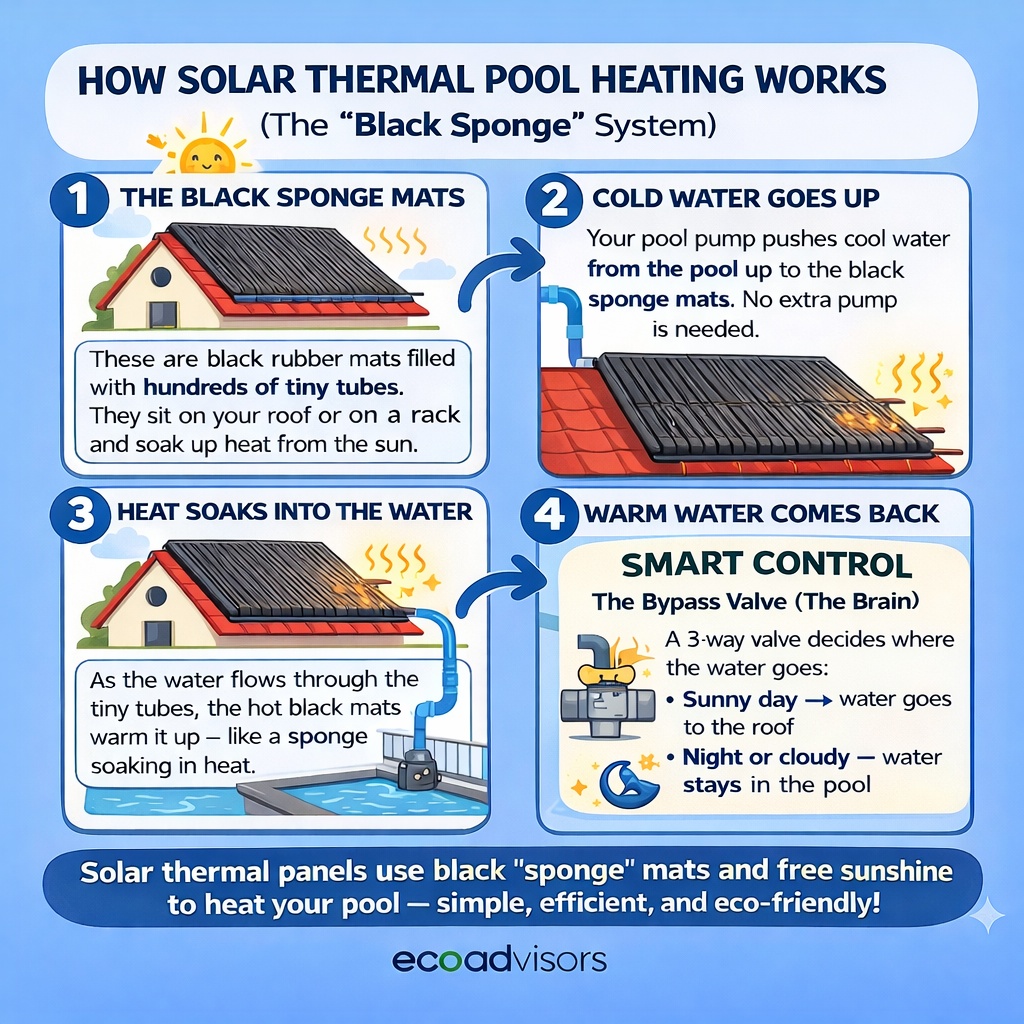
It’s a common mistake: homeowners see those sleek glass panels on a neighbour’s roof and assume that’s the gold standard. But here is the professional reality: while Solar PV (Photovoltaic) panels are brilliant for running your dishwasher, they are often the wrong tool for warming thousands of litres of water.
According to current 2025 data, commercial high end solar PV panels typically operate at an efficiency range of 21% to 24%. This means more than three quarters of the sun’s potential energy is effectively “bounced back” or lost during the conversion to electricity. If you then use that electricity to run a standard heater, you’re losing even more ground.
In contrast, solar thermal collectors are significantly more efficient at capturing energy for water heating, often converting 70% to 90% of available solar radiation directly into heat. Because your pool water flows directly through a professional EPDM mat, you aren’t messing around with middle man conversions.
Think of it as the difference between trying to catch a rainstorm with a tiny teacup (PV) versus a giant bucket (Thermal). If your goal for the 2026 season is to raise the temperature of a family sized pool, solar thermal mats are the undisputed heavyweight champion. They provide more “heat per square metre” than almost any other tech on the market
Why Thermal Wins for Pools: The EPDM Solar Mat Advantage
When it comes down to a choice, the reasons heating a swimming pool with solar thermal systems trumps PV are simple, practical, and highly effective for the UK climate:
- Direct Energy Transfer: In a thermal setup, there is zero conversion process. It’s wonderfully simple: the sun hits your EPDM solar mat, the mat gets hot, and your water takes that heat directly. No wasted energy.
- Massive Surface Area: You can literally cover a huge area of a shed, garage, or pool house roof with thermal mats for a fraction of the cost of expensive, high-tech PV glass. More surface area = more heat harvested.
- Built for Pool Life: High-grade thermal collectors are made from UV-stabilized EPDM or robust polymers that are built to handle pool chemicals and fluctuating UK weather. They don’t have delicate circuitry that can fail.
Ultimately, Solar PV is a broad tool for your whole house, but a dedicated solar thermal system is a precision instrument designed specifically for one job: keeping your pool invitingly warm for free.
The 75% Rule for Heating a Swimming Pool with Solar
When you are planning your setup, the most critical calculation isn’t the price it’s your collector to surface ratio. In the UK, you cannot simply guess how many mats you need. If you undersize the system, the British breeze will strip away the heat faster than your mats can replace it.
The Math: Why the 75% Benchmark Matters
In our climate, sunlight is less intense than in regions like Spain or Florida. To reach a comfortable, inviting temperature of 25°C to 28°C, your solar collectors must cover at least 75% of the total surface area of your pool.
- The Example: If your pool is 8m x 4m, your surface area is 32m².
- The Math: 32m² x 0.75 = 24m².
- The Result: You need 24m² of solar collectors to effectively beat the UK weather.
The Volume Factor: How Depth Changes the Game
The biggest mistake we see homeowners make is ignoring pool depth. While surface area tells you how much heat you can harvest, the volume determines how much heat you actually need to generate.
The 75% rule assumes a standard pool depth of 1.2m (about chest height). If your pool is deeper, you have a much larger “thermal mass” to move, which requires a more robust heater for pool solar setup to do the heavy lifting.
- The Pro Formula: For every 20cm of depth beyond 1.2m, you should increase your collector area by 10%.
- The Reality: If that same 8m x 4m pool is 1.4m deep, you shouldn’t stop at 24m². You actually need 26.4m² to maintain that luxury level of comfort.
Precision Planning with our 2026 Calculator
Below is a calculator we’ve built to save you time. It includes both surface area and the extra volume created by deeper pools. By using this tool, you can identify exactly how much swimming pool solar coverage you need for your specific layout before you spend a penny on hardware.
2026 Solar Pool Sizer
The Hidden Heat Thief: Why Your Garden Is Trying to “Steal” Your Warmth
You can have the most powerful solar array in the world, but if you ignore the floor of your pool, you’re essentially trying to heat a house with the front door wide open.
Here is the “Expert” secret: Heating a swimming pool with solar energy is only half the battle. The other half is keeping it. In the UK, the ground beneath your pool stays a chilly 10°C to 12°C all year round. Without a proper barrier, that cold earth acts like a giant “heat sponge,” constantly sucking the warmth out of your water from below.
The XPS Solution
If you’re installing a new pool for the 2026 season, do not skip on XPS insulation boards (Extruded Polystyrene) beneath your liner. It’s like putting a thermal coaster under a hot cup of tea. Without it, you are wasting about 20% of your solar gain just trying to warm up the soil in your backyard!
By adding that layer of insulation, you ensure that every drop of heat your solar thermal mats collect stays exactly where it belongs—in the water, keeping your family happy and your swimming season long.
Is Heating a Swimming Pool with Solar Right for You? (The Honest Truth)
We love solar, but we love honesty more. While heating a swimming pool with solar is a total game changer for most, it isn’t a magic wand for every garden. You might find a solar mat setup frustrating if you fall into these “red flag” categories:
- The 30-Day Rule: If you only splash around for a few weeks in August, the setup costs might not make sense. Solar is for people who want to own the whole season.
- The “Lid” Constraint: A pool cover is non-negotiable. Without one, your pool loses heat faster than the sky can provide it. It’s like trying to heat a house with the windows smashed.
- Deep Shade: If your garden or roof is blocked by giant trees or high buildings, the math fails. The sun must see the collectors to do its job.
- The Hot Tub Demand: If you want 32°C water during a thunderstorm, you need a hybrid system. Solar provides sustainable, natural warmth.
Expert Tip: If you fit these flags, don’t panic. A high efficiency heat pump might be your best path. Check out our [Heat Pump vs Solar Comparison Guide] to find your perfect match..
The Smart Way to Warm an Intex or Bestway Pool
We’ve all been there: the sun is finally out, the BBQ is lit, and the kids are begging to jump in. But one toe in the water reveals an “Arctic Plunge” rather than a backyard oasis. If you own a portable Intex or Bestway setup, a permanent roof installation is usually expensive overkill.
The good news? You can still enjoy a warm swim without that terrifying 28p per unit electric bill that 2026 has brought us. The secret is a solar powered outdoor heater designed specifically for temporary pools.
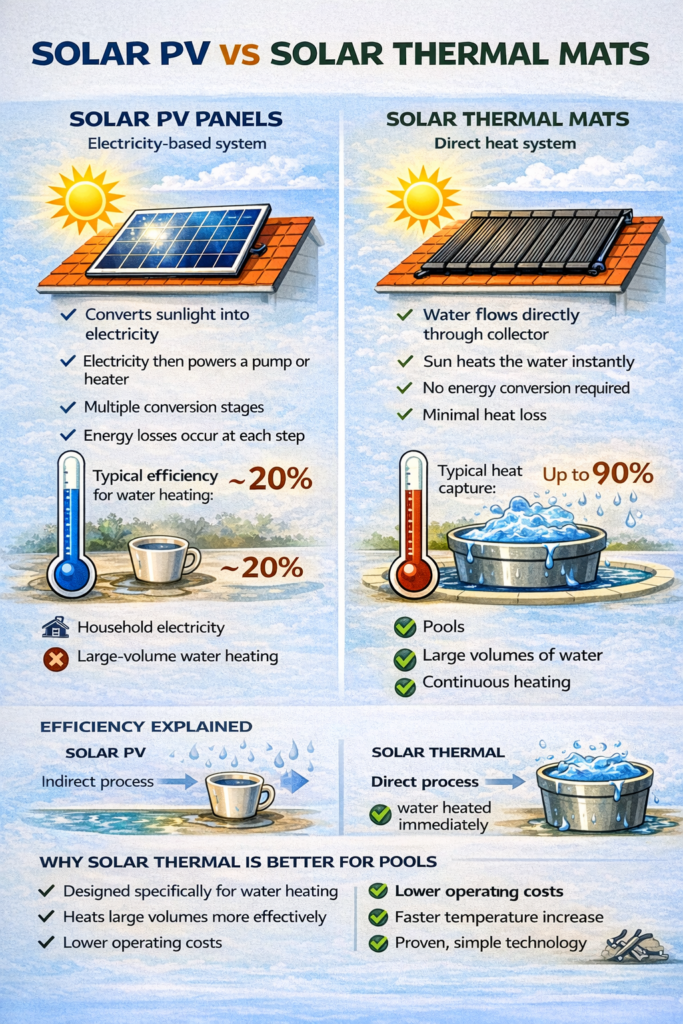
These aren’t flimsy toys they are durable, high performance black mats that sit directly on your lawn. They act as a high performance swimming pool warmer, soaking up free energy and transferring it directly into your water as it circulates. It’s the ultimate plug and play luxury for a British summer
The Efficiency Win
One of the biggest myths is that you need a massive, industrial grade pump to make solar work. In reality, most standard Intex and Bestway pumps (even the entry-level 330gal/3.8L models) have more than enough grunt to circulate water through two or three EPDM solar mats
This is a massive win for your bank account. It means you can build a custom solar heater for the pool without the headache of buying extra booster pumps or complex plumbing fittings. Because these mats have very low flow resistance, your existing filter pump simply hums along, soaking up the heat and pushing it back into the pool.
👉 Get the Step-by-Step Guide: [How to Heat an Intex Pool with Solar]
Direct vs Indirect: The 25 Year Performance Secret
In 2026, the industry is shifting. While entry level setups still rely on direct heating, premium installations have moved toward Indirect Heating. This choice alone determines whether your system lasts for a decade or a generation.
The Issue with Direct Heating
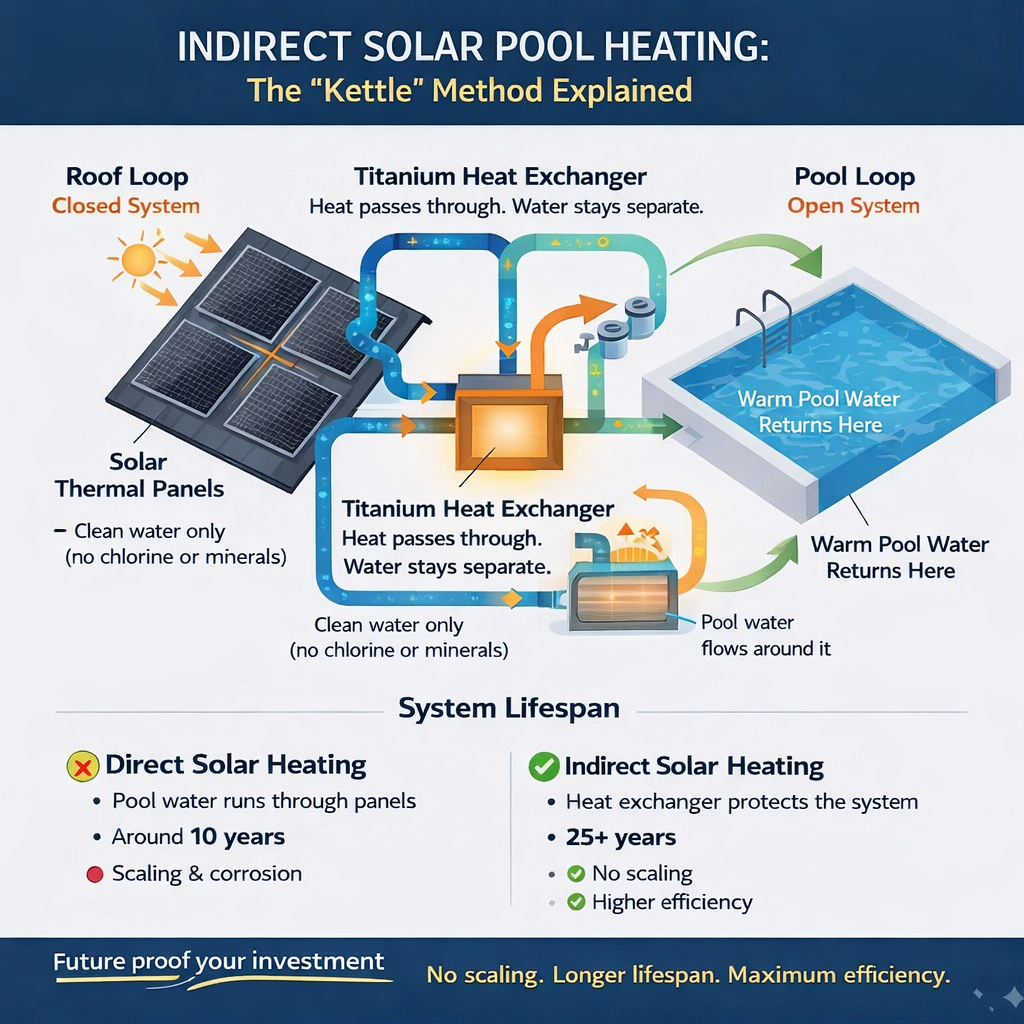
In a direct setup, your chlorinated pool water is pumped all the way to your roof and through your solar collectors. While this sounds simple, it creates a significant long term problem.
Pool chemicals and minerals are naturally aggressive. Over time, they create internal scaling a crusty mineral buildup inside the narrow channels of your solar pool heater. This eventually clogs the flow and reduces efficiency. As a result, Direct systems often see a significant drop in efficiency after 10 years due to mineral scaling
The Indirect Advantage: The Titanium Shield for Heating Your Pool
A professional indirect installation uses a high grade Titanium Heat Exchanger. Think of this like a protective barrier between your heat source and your pool water.
The solar collectors run on a Closed Loop filled with pure distilled water. This fluid never leaves the system and never touches your pool chemicals. It simply transfers its heat through the titanium plates into your pool water.
Why this is a game changer for your property:
- The 20–25 Year Lifecycle: By separating the solar mats from the harsh pool chemicals, you extend the system life from a potential ten years up to twenty five years or more.
- Zero Mineral Buildup: Because the water in the solar panels never changes, it never creates the scaling that chokes traditional pipework. It stays clean forever.
- Chemical Immunity: Titanium is virtually indestructible against chlorine and salt. By using a titanium exchanger, your expensive solar pool heating systems are shielded from chemical erosion forever.
Ultimately, going indirect means you are investing in a fit and forget system that provides free heat for decades rather than just a few seasons. It is the smarter way to use solar pool heaters.
The 3 Way Bypass Valve Authority
A professional installation is defined by control, not just surface area. The 3 way bypass valve is the single most critical component in your plumbing because it acts as a mechanical traffic warden for your water. Without this part, even the most expensive collectors are essentially a guessing game.
Safeguarding Your Investment
Think of your swimming pool pump as a high volume engine. While it is built to move massive amounts of water, your solar collectors are designed for specific, calibrated flow rates.
The bypass valve ensures that only a safe amount of water reaches the roof. This prevents your solar array from experiencing excessive backpressure, which is the leading cause of leaks and split pipes in amateur setups. By managing this pressure, you ensure your solar heater lasts for its full twenty year lifespan without the risk of a catastrophic failure.
Mastering the Dwell Time
Heat transfer is basically a game of “how long can you linger?”
Think of it like this if you sprint past a bonfire, you’ll barely feel a flicker of heat. But if you walk past it slowly, you’ll feel the heat soak into your skin. Water works exactly the same way. The 3 way bypass valve is your tool to slow that water down just enough so it can “linger” in the solar mats and soak up the sun.
When you get this right, the water coming out of the inlet feels like a warm bath. It’s that Aha! moment the proof that the system is working and you’re successfully winning against the British weather.
Now, if we’re being total geeks about this (and in 2026, with energy at 28p a unit, we have to be), there’s a funny bit of physics involved called Newton’s Law of Cooling.
Technically, a faster flow of water is actually better at sucking total energy out of the panels. But there’s a catch fast moving water doesn’t feel as hot when you put your hand in front of the jet.
We use the “Dwell Time” method because it’s the industry standard for a reason perceived performance. There is nothing more satisfying than feeling that hot stream of water hitting the pool. Your mission is to find the Goldilocks Zone not so fast that the water feels cold, but not so slow that you’re barely moving any volume. Find that sweet spot, and you’ve cracked the code.
Eliminating Night time Thermal Siphoning
When the sun sets, your roof temperature drops instantly. Without a bypass valve, your pump would continue sending your warm pool water up to a freezing roof all night long. You would effectively be using your solar panels as a giant radiator to cool your pool down.
The valve shuts the gate to the roof the moment the temperature drops. This ensures the thermal energy you harvested all day stays trapped in the water while you sleep.
The Verdict
A high quality 3 way valve is the definitive difference between a system that works and a system that actually pays for itself. If a quote does not include this component, you are missing the precision control needed for heating a swimming pool with solar power effectively.
The 2026 Strategy: 0% VAT and the “Water Battery”
As we move into 2026, the UK government is essentially giving you a massive helping hand to go green. Heating a swimming pool with solar energy is no longer just a luxury lifestyle choice; it is a brilliant financial move that protects your bank account from the ever-changing energy price cap.
The 0% VAT Gold Rush
The biggest win for your wallet right now is a temporary tax break that many people completely overlook. Under current rules, professional solar thermal installations are sitting at a 0% VAT rate.
On a typical £5,000 setup, this is an instant £1,000 saving compared to the 20% tax you’d be slapped with for a traditional gas boiler replacement. It’s like getting a top-tier upgrade for a bargain price.
- The Ticking Clock: This isn’t forever. As outlined in the official HMRC Energy Saving Materials Notice, the 0% rate is legislated to expire on 31 March 2027. After that, the tax is scheduled to jump back up, potentially adding hundreds of pounds to the exact same job.
- The Simple Rule: To grab this saving, you just need to ensure the equipment and the installation are bought together as one package from your provider.
The Water Battery Revolution
If you already have solar panels on your roof, you might be selling your extra electricity back to the grid for about 5p or 15p per unit. But why sell it for pennies when you’re buying it back at nearly 28p?
Your pool is actually the largest “battery” you own. A standard 40,000-litre pool is a giant thermal mass that can store an incredible amount of energy. Instead of dumping your power back to the grid, you can divert it into your swimming pool solar water heaters.
By doing this, you are “charging” your pool with free heat during the daylight hours. This water battery approach lets you store that energy so you can enjoy a warm, luxury swim at sunset without spending a single penny on grid electricity. By using solar pool heaters as your storage solution, you aren’t just warming the water—you’re reclaiming your energy independence.
Step by Step Winterisation
Protecting Your Investment
The only thing that can truly kill a solar heater for the pool is a harsh British winter. When water freezes, it expands by approximately 9%. If that water remains trapped inside your mats or pipes, it will burst the collectors and ruin your system before the first daffodil of spring even arrives.
To ensure your investment survives the frost, you need to go beyond just draining the pipes. For the 2026 season and beyond, you need to ensure they are bone dry.
1. Isolate the System
Close your 3-way bypass valve before the first frost hits in late October or November. This shuts the gate and prevents any new water from entering the roof array while you are not using it.
2. The Wet Vac Method
Do not rely on gravity alone to drain the system. Water can easily get trapped in the dips of your solar mats. Attach a high-powered wet vac to the highest point of your roof plumbing.
3. Listen for the Whistle
Run the vacuum until you hear a clear, high pitched whistle of air moving through the collectors. That sound is your absolute guarantee that the pipes are empty, dry, and safe from the ice.
By taking five minutes to perform this whistle test, you are safeguarding your heating your swimming pool with solar setup for decades to come. It is the difference between a stress free opening in April and a heart-breaking repair bill in the spring..
Final Verdict: Is it Actually Worth the Investment?
If you plan on staying in your home for the next few years, installing a solar powered heater for pool use is easily one of the smartest moves you can make for 2026. Here is the reality of the situation:
From “Money Pit” to Family Favourite
Let’s be real—most UK homebuyers see a swimming pool and immediately think of “bill anxiety.” By switching to solar, you completely flip the script. You’re transforming your pool from a financial drain into a self-heating, luxury feature that you can actually afford to use every single day.
The 2026 “Green Premium” is Real
Energy efficiency isn’t just for tech-heads anymore; it’s a primary driver for house sales. Buyers in 2026 are actively hunting for “future-proofed” homes where the big bills have already been dealt with.
- The 7% Value Boost: A massive Swansea University study recently confirmed that solar installations can hike up UK property values by an average of 6.1% to 7.1%. On a standard home, that’s an equity boost of roughly £16,000 to £20,000.
- The Buyer Magnet: A solar-heated pool is a massive “luxury signal.” It tells a buyer that your property is modern, efficient, and ready for the next decade. You aren’t just selling a house; you’re selling a lifestyle with zero running costs.
True Energy Freedom
At the end of the day, the biggest win is emotional. When you master heating a swimming pool with solar, you stop being a victim of the next energy price cap announcement. You gain the freedom to keep your water at that perfect “holiday temperature” on your own terms, powered by the sky rather than a monthly direct debit.
The Bottom Line: With the 0% VAT window closing on 31 March 2027 and grid prices still biting, 2026 is the golden year to act. It’s time to stop paying for your pool and start letting your pool pay you back.
QUESTIONS AND AWNSERS
Yes, but you need the right tool for the job. In 2026, the most effective way to do this in the UK is through solar thermal collectors. These are specifically designed for heating a swimming pool with solar energy by circulating water through a series of tubes that absorb the sun’s heat directly. Unlike electrical PV panels, which are for your kettle, these systems focus entirely on transferring maximum thermal energy into your water.
The real secret to solar efficiency in the UK isn’t just the mats; it’s the 3-way bypass valve. This clever component acts as a manual or automatic switch. It directs your water either to the solar panels or directly back into the pool. To heat effectively, you must bypass the solar panels whenever the sun is not shining.
For the UK 2026 season, aim for 50% to 75% collector coverage. Based on a standard 4m² solar mat, here is what you need:
Small Pool (6m x 3m): You need 3 to 4 mats.
Medium Pool (10m x 5m): You need 7 to 10 mats.
For a precise count tailored to your pool’s depth and wind exposure, try our 2026 Solar Sizer Calculator here.
Manual 3-Way: This is the best choice for budget-conscious homeowners. It works perfectly, but you must be there to turn the handle yourself. If you forget to bypass the roof when it rains or at night, your mats will act as a radiator and cool your pool down.
Digital Actuator (Recommended): This adds a motor and sensors to your valve. It automatically detects when the roof is hotter than the water and flips the switch for you.
Absolutely. With electricity prices at the confirmed January 2026 cap of 27.69p per kWh, a solar heater is the only way to escape the “money pit” trap. Most UK homeowners find the system pays for itself in savings within 3 to 5 seasons.
Yes. Modern solar pool heater systems harvest diffuse radiation: sunlight filtered through clouds.
While direct sun is strongest, diffuse light still carries thermal power. In the UK, high grade collectors generate heat even on grey days. They also soak up ambient warmth from the air.
This is why a 3 way bypass valve is vital; it captures this “free” heat when available but shuts the loop if the panels start losing warmth to a cold sky. You can read more about how this works in our diffuse radiation section.